
Recognition Before Relief: What’s the point of the Ferla and LAD skits?
January 25, 2026
Welcome to Interwoven
If you’re a mental health practitioner, you probably know what it feels like to give more than you have—to care deeply for others while setting your own needs aside. It’s a reality many in this field accept as part of the job.

But what if care could flow both ways?
Picture a place created with your well-being at its core—a space that supports you as you hold space for others. A place where your needs are heard, honored, and met. Where care for the caregiver isn’t an afterthought, but the guiding principle. Some call it a dream. Others say, “It sounds a little idealistic.” But what if it’s not? What if reimagining care—for therapists, for case-workers, for anyone who carries the weight of others—could change the way we all thrive? Maybe the reason it feels so far-fetched is because so few of us have ever experienced what true support in this field actually feels like. I know I hadn’t.
When I worked in community mental health, I often felt like I needed more support just to keep going. Every day I listened to stories of trauma and heartbreak while trying to stay calm and compassionate, but there was rarely space to process any of it myself. We talk about “self-care,” yet it feels impossible when you’re overbooked and buried in notes.
What wore me down wasn’t the people I served—it was the way I was expected to serve them. There was no slowing down, no one asking how I was really doing, and no system for emotional support. I learned to compartmentalize just to survive. Over time, that survival mode changed me—I became efficient, detached, and mechanical. The cruel irony was that the work meant to heal others was quietly eroding my own humanity.
What kept me going were the small sparks of connection—a breakthrough, a thank-you note, a shared laugh. But deep down, I knew I couldn’t sustain it. I was depleted, absorbing everyone else’s pain and losing sight of my own. I needed someone to see me, to say, “this is too much,” and to help me find a way out when I no longer had the strength to do it myself.
Now, that’s just my experience—your experience and needs might be completely different. And that’s exactly why Interwoven matters.
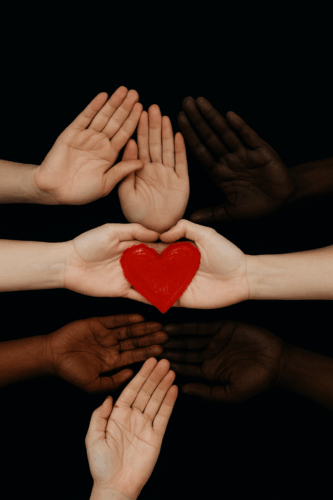
When we come together to reimagine care, we start to build what’s been missing. Because real care is never one-size-fits-all. When the community builds it, the walls hold more than structure—they hold story, meaning, and care. Every voice, every hand, every idea leaves a fingerprint, a quiet reminder that healing is something we create together. It’s no longer a resource handed to us, but a space born from us—one that reflects our collective needs, wisdom, and lived experience.
When practitioners and community members come together to build something, it becomes more authentic, more sustainable, and more deeply responsive to real human needs. Co-creation fosters ownership and accountability; it ensures the center grows out of understanding rather than assumption. It becomes a living, breathing ecosystem of care—one that values the healer as much as the healing, and recognizes that true support can only thrive when it’s rooted in shared experience.
The act of building together is, in itself, a form of healing. It invites connection where isolation once lived, belonging where burnout once hurt, and hope where exhaustion once settled. In creating the space, we begin to practice the very care we’ve all been missing.
At the heart of Interwoven is a simple belief: care grows stronger when it’s shared. It’s a living, ever-evolving community of care — a space designed to nurture the people who nurture others.
